
Trying to answer “What career is right for me?” can be difficult when job titles reveal so little about the work.
One technology professional may spend the day restoring network access. Another writes code, tests an application, coordinates a system rollout, investigates suspicious activity, or checks whether a configuration meets an established standard.
The useful question is not whether one title sounds impressive. Consider which problems hold your attention and what kind of result feels satisfying. You can learn the tools later.
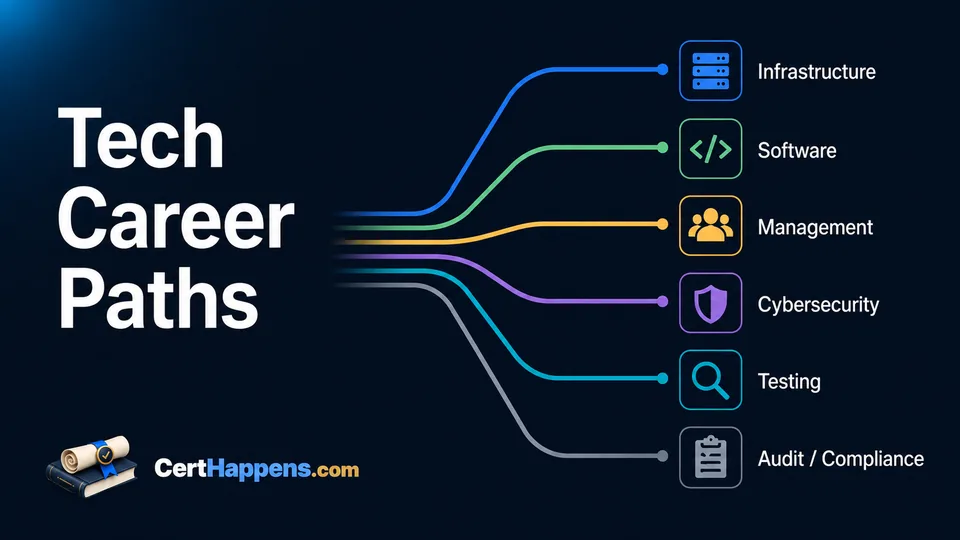
This guide compares six broad technology directions:
- IT operations and infrastructure
- Software development and automation
- Technology management and coordination
- Cybersecurity
- Quality, testing, and improvement
- Audit, compliance, and technical assurance
Many jobs combine two or more of these areas. The career self-assessment below returns your two strongest matches rather than forcing every interest into one category. Your results appear as soon as you answer all eight questions. No email address or account is required, and the quiz does not ask for your name or contact information.
Practical self-assessment
2. Find your strongest technology career directions
Choose the work that sounds most interesting, even when you have not learned the skill yet. The assessment returns your two strongest matches.
Progress and results are saved in this browser tab.
Your results
Your strongest technology career matches
Your answers suggest that you may enjoy...
These results are a starting point for exploration. Skills and interests can overlap across several paths.
Continue below to compare all six paths in more detail. Each section includes common roles, the kinds of problems you may handle, and a small project that can help you explore the work.
3. IT Operations and Infrastructure
People in IT operations keep technology available, connected, and supportable. They configure systems, manage accounts, maintain networks, investigate failures, monitor performance, and restore services when something goes wrong.
Common roles include:
- IT support specialist
- Systems administrator
- Network administrator
- Cloud administrator
- Network engineer
- Infrastructure engineer
A typical problem might begin with a user who cannot reach an application. The cause could be a locked account, a failed service, a name-resolution problem, an incorrect route, a damaged cable, or a change made somewhere else. The work requires narrowing the possibilities without guessing.
This direction may fit you when you like concrete problems and visible results. Some issues need an immediate fix. Others require a lasting configuration change, better monitoring, clearer documentation, or automation.
Try a small infrastructure project
Create two virtual machines or use two computers on the same network. Configure user accounts, share a folder, test permissions, and document the steps another person would need to repeat the setup.
Notice what interests you most. You may enjoy configuring the environment, tracing connection problems, improving reliability, or writing the instructions.
4. Software Development and Automation
Developers turn requirements and ideas into working software. That may involve a large application, a website, an integration, a small internal tool, or a script that removes repetitive work.
Common roles include:
- Software developer
- Web developer
- Application developer
- Automation engineer
- Integration developer
- DevOps engineer
The work often includes understanding a problem, dividing it into smaller steps, writing code, testing behavior, reviewing changes, and debugging results that were not expected. Existing software needs maintenance too. Developers spend a meaningful amount of time reading and changing code that someone else wrote.
This direction may fit you when you enjoy building useful things and experimenting until a solution works. Patience matters. A program that almost works can take longer to repair than the first draft took to write.
Try a small development project
Choose one beginner-friendly language and build a program that accepts information, performs a useful task, and displays a result. It could organize a list, rename files, calculate study progress, check whether a website responds, or summarize a small data file.
The project does not need to be original. Pay attention to whether you enjoy designing the steps, writing the code, and finding the reason an incorrect result occurred.
5. Technology Management and Coordination
Technology work crosses several teams. Developers, infrastructure specialists, security staff, vendors, business leaders, and end users may all depend on the same decisions. Someone must organize the work and keep the larger result visible.
Common roles include:
- Technical project manager
- IT project manager
- Program manager
- Product manager
- Scrum master
- Technology team lead
- Engineering manager
- IT manager
Project and people management are related, but the daily responsibilities differ. A project manager may focus on scope, schedule, dependencies, risks, decisions, and delivery. A team manager may spend more time setting priorities, developing employees, assigning work, planning staffing, and representing the team.
This direction may fit you when you like creating order from incomplete information, helping specialists work together, and keeping attention on the intended outcome. Technical literacy helps a manager ask better questions and recognize when a deadline depends on an unresolved technical decision.
Try a small management project
Plan a modest technology effort, such as setting up a home lab or launching a small website. Identify the goal, required tasks, owners, dependencies, risks, and decisions. Then write a brief progress update for someone who is not performing the work.
You may find that organizing the effort is as interesting as completing the technical tasks.
6. Cybersecurity
Cybersecurity work focuses on technology risk, misuse, weaknesses, suspicious activity, and the controls used to protect systems and information.
The field contains several different directions:
- Defensive teams monitor systems, investigate alerts, manage vulnerabilities, and respond to incidents.
- Offensive teams test systems and applications to find weaknesses before a real attacker uses them.
- Purple teams connect offensive and defensive work by testing realistic techniques, observing detections, and improving the response.
- Security engineers design and maintain controls, identity systems, monitoring, and safer technical architectures.
- Risk and governance professionals help organizations understand exposure, choose controls, and make defensible decisions.
Other specialties include application security, cloud security, digital forensics, incident response, threat hunting, identity and access management, security awareness, and privacy.
This direction may fit you when you consider how technology could be misused, how damage could be reduced, or how evidence can reveal what happened. Networking and operating-system knowledge make security tools easier to understand because you can recognize normal behavior in the underlying systems.
Try a small security project
Draw a diagram of your home network. Include computers, phones, smart devices, the router, wireless connections, user accounts, and cloud services.
Identify the information that matters, who or what can access each device, which failure would cause the most disruption, and how you might notice suspicious activity. This is a simple form of threat modeling and requires no specialized equipment.
7. Quality, Testing, and Improvement
Quality assurance professionals examine whether technology behaves as expected. They design tests, reproduce defects, document unexpected behavior, verify corrections, and check whether a change caused a problem somewhere else.
Common roles include:
- Quality assurance analyst
- Software tester
- Test engineer
- Quality engineer
- User acceptance testing analyst
- Test automation engineer
A useful defect report explains the exact steps that produced a problem, what should have happened, what happened, and which environment was used. “The page is broken” may be true, but it gives the developer little to investigate.
This direction may fit you when you notice inconsistencies, enjoy exploring edge cases, and can describe a problem well enough for someone else to reproduce it. People who enjoy both testing and development may move toward automated testing or software quality engineering.
Try a small testing project
Choose a website form or a small application. Test normal information, missing information, incorrect formats, very long entries, repeated submissions, and unexpected navigation.
Write a short defect report for anything that behaves incorrectly. Include the steps, expected result, actual result, and enough detail for another person to repeat the test.
8. Audit, Compliance, and Technical Assurance
Audit and technical assurance professionals evaluate whether systems and processes meet defined requirements. Those requirements may come from internal policies, contracts, laws, industry standards, configuration baselines, or security frameworks.
Common roles include:
- IT auditor
- Cybersecurity auditor
- Compliance analyst
- Security controls assessor
- Risk analyst
- Configuration compliance analyst
- Technical assurance analyst
The work may involve reviewing policies, examining configurations, interviewing process owners, collecting evidence, identifying gaps, documenting findings, and confirming corrective action.
Technical assurance can become highly technical. In government and defense environments, reviewers may analyze Security Technical Implementation Guides, commonly called STIGs. They determine whether each configuration requirement is satisfied, not applicable, or covered by an approved exception. Understanding the system matters because a checked box does not prove that a control works.
This direction may fit you when you enjoy structured investigation, evidence, standards, and careful documentation. Good reviewers explain why a finding matters and what evidence would demonstrate that it has been corrected.
Try a small assurance project
Create a short security checklist for one device. Include user accounts, authentication, software updates, firewall settings, screen locking, backups, and installed applications.
Review the device against each requirement. Record the evidence, identify gaps, and describe what would correct them.
9. How Your Two Results May Work Together
Technology careers can form at the intersection of two interests.
IT operations and development can lead toward infrastructure automation, platform engineering, DevOps, or site reliability work.
IT operations and cybersecurity overlap in network security, security engineering, identity administration, vulnerability management, and defensive operations.
Development and cybersecurity can lead toward application security, secure software development, DevSecOps, security tooling, or vulnerability research.
Development and quality assurance meet in automated testing, software quality engineering, and continuous integration pipelines.
Cybersecurity and technical assurance overlap in governance, risk, compliance, security assessments, configuration reviews, and control testing.
Management paired with another result may point toward project management, product management, program leadership, team management, or service delivery within that specialty.
Job titles vary between employers. Read the responsibilities and repeated tasks rather than relying on the title alone.
10. Explore the Work Before Choosing a Path
Choose one or two small projects from the career sections above and spend some time with each. Pay attention to which tasks hold your interest, which problems you want to keep solving, and which results feel satisfying.
A short hands-on project can reveal more than another list of job titles. You may discover that you enjoy troubleshooting but not extended coding, or that reviewing evidence appeals to you more than responding to a live technical incident.
Read several job descriptions related to each of your two results. Ignore the experience requirements during the first review and focus on the responsibilities that appear repeatedly. Consider whether you would enjoy performing those tasks several times each week.
Your first role does not need to define your entire career. Experience in support, networking, development, testing, project coordination, or audit can become useful in another technology specialty later.