
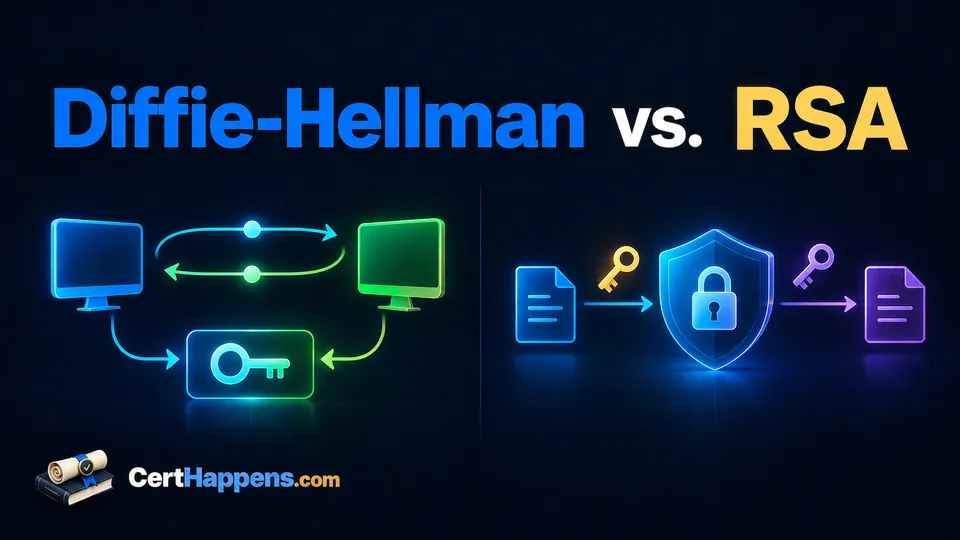
Diffie-Hellman and Rivest-Shamir-Adleman (RSA) often appear in the same paragraph, the same protocol diagram, and the same exam question. That makes them look interchangeable. They are not.
The easiest way to separate them is to stop asking, “Which one is the encryption algorithm?” and ask a better question:
What job needs to be done?
A secure connection may need to establish shared key material, authenticate a server, create a digital signature, encrypt a small piece of data, and then protect a large stream of application traffic. Those are different jobs. One protocol can use several cryptographic mechanisms together because each one handles a different part of the problem.
That is why a web server can have an RSA public key in its certificate while the connection still uses Elliptic Curve Diffie-Hellman Ephemeral (ECDHE) to establish session keys.
Nothing is being duplicated. The algorithms are doing different work.
2. Start by Asking What Job Needs to Be Done
Before choosing an algorithm, identify the requirement.
| Job | Diffie-Hellman | RSA |
|---|---|---|
| Establish shared secret material | Yes. This is the core Diffie-Hellman job. | RSA can participate in key-establishment schemes, and RSA key transport was historically used in TLS. |
| Create a digital signature | No. | Yes, with an RSA signature scheme such as RSASSA-PSS. |
| Encrypt data with a recipient public key | No. Diffie-Hellman does not directly encrypt a message. | Yes, with an RSA encryption scheme such as RSAES-OAEP. |
| Encrypt bulk application traffic | No. | Not the normal choice. |
| Provide forward secrecy | Ephemeral DHE or ECDHE can. | Long-term RSA key transport does not. |
The bulk traffic part is worth emphasizing. Modern protocols normally use fast symmetric encryption after session keys have been established. Diffie-Hellman can help derive those keys. RSA can authenticate or protect small values in appropriate schemes. Neither one is the usual tool for encrypting an entire video stream, file transfer, or long HTTPS session.
3. Diffie-Hellman Establishes Shared Key Material
Diffie-Hellman is a key-agreement mechanism.
Two parties each create private information and a corresponding public value. They exchange the public values. Each side combines its own private value with the other side's public value and arrives at the same shared secret material.
The shared secret itself is not sent across the network.
A simplified view looks like this:
Client private value + Server public value -> shared secret
Server private value + Client public value -> same shared secret
An observer can see the public values but should not be able to efficiently recover the private values or derive the same shared secret when appropriate parameters and implementations are used.
Protocols normally feed the Diffie-Hellman result into a key-derivation function instead of treating the raw shared secret as an application encryption key. The derived keys can then be used by symmetric cryptography to protect the actual session.
There are several Diffie-Hellman families you may encounter:
- DH or finite-field DH uses arithmetic in a finite field.
- Elliptic Curve Diffie-Hellman (ECDH) uses elliptic-curve groups.
- Diffie-Hellman Ephemeral (DHE) and Elliptic Curve Diffie-Hellman Ephemeral (ECDHE) use temporary key pairs intended for a session rather than long-lived static key pairs.
For most learners, the durable concept is more useful than the math at first:
Diffie-Hellman lets both sides contribute to establishing shared secret material without sending that shared secret over the network.
4. RSA Can Encrypt or Sign
RSA is more flexible in the kinds of operations it can support.
With an RSA encryption scheme, a sender can use the recipient's public key to encrypt appropriate data. The recipient uses the corresponding private key to decrypt it.
With an RSA signature scheme, the holder of the private key creates a digital signature. Other parties use the public key to verify the signature.
Those are different operations with different security goals.
Do not reduce signing to “encrypting with the private key.” That shortcut creates bad mental models. RSA signature schemes have defined encoding, hashing, and verification rules. A digital signature proves something about possession of the signing private key and protects integrity of the signed data. It is not ordinary confidentiality run backward.
RSA is also not normally used to encrypt large amounts of application data directly. Public-key operations are expensive compared with symmetric encryption, and RSA encryption schemes have strict message-size and encoding requirements.
A common real-world pattern is therefore:
public-key cryptography -> establish trust or key material
symmetric cryptography  -> protect the ongoing data stream
5. Key Agreement and Key Transport Are Different
This distinction explains much of the confusion between Diffie-Hellman and RSA.
With key agreement, both parties contribute information used to establish the resulting shared key material. Diffie-Hellman is the classic example.
With key transport, one party obtains or creates key material and securely delivers it to the other party. RSA encryption can be used for this type of design.
Older TLS versions supported an RSA key-transport pattern. The client generated a premaster secret and encrypted it with the server's RSA public key. The server decrypted it with its RSA private key, and both sides used the result to derive session keys.
So the statement “RSA cannot be used for key establishment” is too broad.
The better distinction is:
- Diffie-Hellman is fundamentally a key-agreement mechanism.
- RSA supports encryption and signatures and has been used in key-establishment schemes, including key transport.
- Modern TLS 1.3 no longer uses static RSA key exchange.
That last point explains why current protocol diagrams often show an RSA certificate and Diffie-Hellman key agreement in the same handshake.
6. Modern TLS 1.3 Shows the Roles Side by Side
Transport Layer Security (TLS) 1.3 is a useful example because it deliberately separates authentication, key exchange, and record protection.
A simplified certificate-authenticated TLS 1.3 handshake may involve these jobs:
- The client and server exchange supported parameters and ephemeral key shares.
- A Diffie-Hellman-based mechanism such as ECDHE contributes to shared secret establishment.
- The server sends its certificate chain.
- The server proves possession of the certificate's private key with a digital signature in the
CertificateVerifymessage. - Both sides derive traffic keys.
- Symmetric authenticated encryption protects application data.
An RSA certificate can still fit into this process. RFC 8446 permits RSA signature algorithms for certificate authentication and CertificateVerify, while the session key exchange is handled separately.
TLS 1.3 removed static RSA and static Diffie-Hellman cipher suites. Its public-key based key exchange mechanisms provide forward secrecy.
So if you see:
RSA certificate + ECDHE key exchange + AES session encryption
there is no contradiction.
A useful translation is:
RSA certificate/signature -> prove who controls the authenticated private key
ECDHE                     -> establish fresh shared secret material
Advanced Encryption Standard (AES) or ChaCha20 -> protect the application data
7. Diffie-Hellman Alone Does Not Authenticate Anyone
Plain Diffie-Hellman can establish a secret with whoever is on the other end of the exchange. By itself, it does not prove that the other endpoint is the server, user, or organization you intended to reach.
That leaves room for a man-in-the-middle attack if the exchange is not authenticated.
Imagine an attacker sits between Alice and Bob:
Alice <-> Attacker <-> Bob
If Alice and Bob accept unauthenticated Diffie-Hellman values, the attacker can establish one secret with Alice and another secret with Bob. Each victim may believe the secure session is directly with the other person.
Protocols solve this by authenticating the exchange. Depending on the protocol, that can involve digital signatures, certificates, pre-shared keys, or other authenticated mechanisms.
This is another reason RSA and Diffie-Hellman can appear together. Diffie-Hellman handles shared secret establishment. An RSA signature can help authenticate the handshake.
The important rule is:
Key agreement and authentication are separate security goals.
Do not award Diffie-Hellman authentication simply because it uses public values. Do not award RSA confidentiality simply because you saw a certificate with an RSA public key.
8. Ephemeral Diffie-Hellman Changes What a Later Key Theft Reveals
Forward secrecy protects past sessions from a later compromise of a long-term authentication key.
Suppose an attacker records encrypted traffic today and steals the server's long-term RSA private key next year.
With historical RSA key transport, that long-term RSA key may allow the attacker to recover recorded premaster secrets and reconstruct old session keys, depending on the protocol and captured handshake data.
With properly implemented ephemeral Diffie-Hellman, the session used temporary private values that were discarded after they were no longer needed. Compromising the server's long-term authentication key later does not reveal those old ephemeral private values.
That is why the E matters in DHE and ECDHE.
Do not memorize “Diffie-Hellman equals forward secrecy” without the qualifier. Static Diffie-Hellman does not provide the same property. Forward secrecy depends on using ephemeral session key material correctly and discarding it when it is no longer needed.
9. Match the Scenario Clues to the Job
When a certification question or technical explanation mentions several cryptographic terms, translate the wording into a required job before choosing an answer.
| Scenario clue | Likely concept | Reason |
|---|---|---|
| Two parties need to derive shared secret material over an untrusted network. | Diffie-Hellman | Key agreement is the core job. |
| A server must prove it controls the private key associated with its certificate. | Digital signature, possibly RSA | The requirement is authentication and proof of private-key possession. |
| A sender encrypts a small value using the recipient's public RSA key. | RSA encryption | The public key provides confidentiality for data that the matching private key can decrypt. |
| A recorded session should remain protected even if a long-term server key is compromised later. | Ephemeral DHE/ECDHE | The requirement is forward secrecy. |
| Gigabytes of application traffic need confidentiality and integrity. | Symmetric authenticated encryption | Neither RSA nor Diffie-Hellman is the normal bulk-data cipher. |
This job-first approach is more reliable than looking for one trigger word and choosing the algorithm you remember seeing beside it.
10. Avoid the Common Mix-Ups
“Diffie-Hellman encrypts the session.”
Diffie-Hellman establishes shared secret material. A symmetric cipher normally protects the session data afterward.
“RSA is only for encryption.”
RSA supports defined encryption schemes and digital signature schemes. In modern TLS, an RSA key may be used for authentication even though RSA is not the key exchange mechanism.
“If the certificate uses RSA, the connection uses RSA key exchange.”
The certificate's public key algorithm does not tell you the whole key-exchange story. TLS 1.3 explicitly separates signature algorithms from key exchange groups.
“Diffie-Hellman authenticates the server.”
Unauthenticated Diffie-Hellman does not establish identity. The exchange must be authenticated by the surrounding protocol.
“Signing is encrypting with the private key.”
That shortcut hides important differences between signature and encryption schemes. Treat digital signatures as their own operation: the private key signs and the public key verifies.
“RSA can never establish keys.”
RSA has been used in key-establishment designs, including key transport. The modern practical lesson is narrower: TLS 1.3 removed static RSA key exchange and uses separate key-exchange mechanisms that provide forward secrecy.
11. Use One Decision Rule
When Diffie-Hellman and RSA appear in the same question, diagram, or troubleshooting conversation, write the required job in the margin before thinking about the algorithm.
Ask:
- Need shared secret agreement? Think Diffie-Hellman, often DHE or ECDHE.
- Need an RSA signature? The private key signs; the public key verifies.
- Need RSA confidentiality for a small value? The recipient's public key encrypts; the private key decrypts.
- Need server identity? Look for authentication, certificates, signatures, and trust, not key agreement alone.
- Need past sessions protected after later long-term key compromise? Look for ephemeral key agreement and forward secrecy.
- Need to encrypt the actual data stream? Look for the symmetric session cipher.
You do not need to choose between Diffie-Hellman and RSA as if one must replace the other everywhere.
The better question is the one this article started with:
What job is each mechanism doing?
Once that is clear, the protocol diagram usually becomes much easier to read.
12. Official References
- NIST SP 800-56A Rev. 3: Recommendation for Pair-Wise Key-Establishment Schemes Using Discrete Logarithm Cryptography
- NIST SP 800-56B Rev. 2: Recommendation for Pair-Wise Key-Establishment Using Integer Factorization Cryptography
- RFC 8017: PKCS #1: RSA Cryptography Specifications Version 2.2
- RFC 8446: The Transport Layer Security (TLS) Protocol Version 1.3
- RFC 7919: Negotiated Finite Field Diffie-Hellman Ephemeral Parameters for TLS