
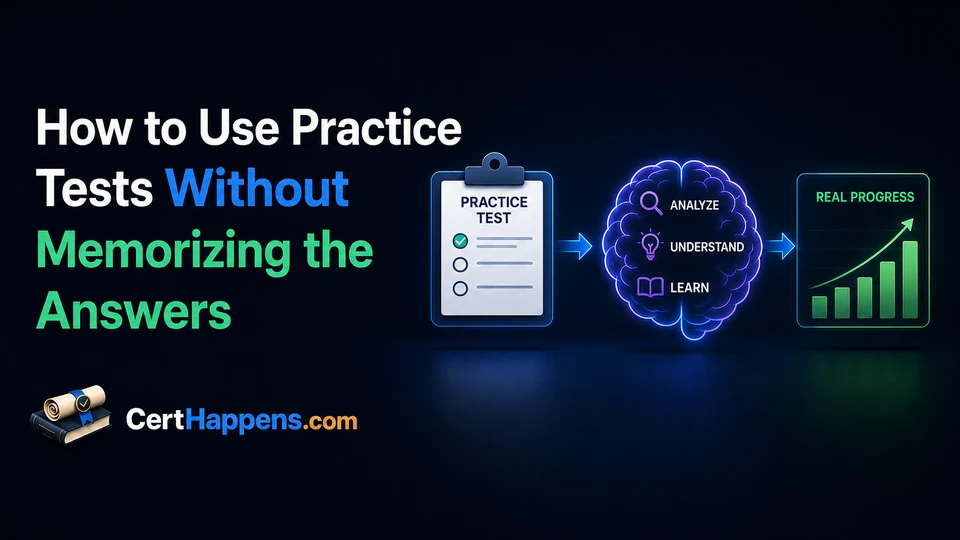
Practice tests are supposed to measure what you know.
After enough repetitions, they can start measuring something else: how well you remember the practice bank.
That is not a failure of practice testing. Repetition creates familiarity.
The problem appears when a familiar answer feels like understanding.
You see the opening sentence, remember that the correct choice was "C" last time, and answer before you have solved the problem.
Your score rises.
Your knowledge may not have risen by the same amount.
The goal is not to avoid repetition. The goal is to use repetition in a way that keeps testing the concept, not your memory of the question.
2. What Practice Tests Are For
A practice test can serve several useful purposes:
- Reveal weak objectives
- Show whether you can apply a concept in a scenario
- Expose confusion between similar terms
- Test pacing
- Practice reading carefully
- Show which distractors repeatedly attract you
- Build confidence with the exam format
- Help decide what to study next
Notice what is not on that list:
Proving that you can score 100% on the same questions after seeing them several times.
A perfect repeated score can feel good. It may also tell you little.
The most valuable information from a practice test is often the reason behind the mistakes and uncertain answers.
3. How Question-Bank Memorization Happens
Memorization can be subtle.
You may remember the shape of the scenario, a distinctive phrase, the position of the correct answer, a line from the explanation, or which two similar options were not correct.
This creates a shortcut.
Instead of reasoning from the scenario to the answer, your brain goes from the scenario to the memory of the prior result.
That shortcut can help with vocabulary. It is less useful when the real exam changes the wording, context, or answer choices.
4. Separate Your Score From Your Learning
A practice-test score is one result. Your learning is a larger pattern.
After a test, ask:
- Which correct answers were guesses?
- Which questions took too long?
- Which topics felt familiar only because I had seen the question before?
- Which wrong answers exposed an actual knowledge gap?
- Which wrong answers came from misreading the task?
- Which answers would I struggle to explain to someone else?
A lower score on unfamiliar questions can be more useful than a higher score on a bank you know by memory.
The lower score gives you new information.
5. Review Correct Answers You Were Not Sure About
Reviewing only wrong answers hides lucky answers.
Before checking the result, mentally classify each answer:
- Confident: I know why this is the best answer.
- Uncertain: I think this is right, but I am not sure.
- Guess: I do not have enough knowledge to justify this choice.
Then review every uncertain and guessed answer.
A correct guess should go into the same study queue as a wrong answer.
Otherwise the score hides the weakness.
6. Explain Why the Distractors Are Wrong
A strong way to test whether you understand a question is to explain all of the options.
Do not stop at "B is correct."
Ask why B is correct, why A is wrong, why C is tempting, when D might be correct, and which clue rules out the closest distractor.
This forces you to work with the concept rather than the remembered answer.
It is useful for questions asking for the best, first, next, or most appropriate action.
7. Space Repeated Attempts
Retaking the same full practice test immediately tells you less than you think.
The previous questions and explanations are still fresh.
Between attempts, study weak topics, use a different set, do a small lab, review an objective section, or explain difficult concepts without notes.
The spacing does not need a rigid number of days.
The point is to let the memory of the exact questions fade enough that the next attempt requires more reasoning.
If you can predict the answer before reading the full question, the bank is too familiar to be a strong readiness measure.
8. Change the Question Yourself
You can get more value from a familiar question by changing one part of it.
If the original asks for the first response to an incident, change it to the best long-term mitigation, the evidence to collect, what happens after containment, or which control prevents recurrence.
You can also change the environment:
- One user becomes an entire department
- An internal system becomes a cloud service
- A wired connection becomes wireless
- One failed login becomes repeated logins from several locations
- A configuration issue becomes a physical-layer issue
Now the remembered answer may no longer work.
You have to use the underlying concept.
9. Rotate Study and Testing
Practice tests should not replace study.
A useful cycle looks like this:
Test → review → study → apply → test again
If you go test → test → test → test, a higher score may reflect bank familiarity more than learning.
After a practice session, choose a few specific weaknesses and work on them.
Re-read an objective section, draw a diagram, build a short lab, compare confusing concepts, explain the topic aloud, or write a tiny scenario and solve it.
Then return to testing.
10. Use Short Mixed Sessions Between Full Tests
Full-length practice tests are useful for pacing and endurance.
They are not always the best study tool.
Short mixed sessions can help you work on application without exposing yourself to the entire bank again.
For example:
- 10 mixed questions after reviewing a weak topic
- 15 questions across two weak domains
- 20 questions with no immediate retake
- A small set focused on scenario reasoning
- A few questions followed by explanation of every option
Short sessions also make it easier to stop and study when a gap appears.
11. Track Why You Missed the Question
Not every wrong answer means the same thing.
Use a few simple categories:
- Did not know: The concept was unfamiliar.
- Mixed up: Two concepts were confused.
- Misread: A task word or detail was missed.
- Applied badly: The definition was known, but the scenario was handled incorrectly.
- Changed answer: Good reasoning was abandoned without new evidence.
- Rushed: Timing caused the mistake.
- Familiarity: The remembered bank influenced the answer more than the scenario did.
This gives you a better study plan.
A knowledge gap needs study. A reading error needs slower task identification. A timing problem needs pacing practice. Familiarity needs more spacing or unfamiliar questions.
12. Know When to Stop Retesting the Same Bank
Another run adds little when you recognize most questions before reading them fully, remember the correct option before reading all choices, can predict the explanation, or are taking the test to see the high score again.
At that point, stop using that bank as a readiness measurement.
You can still use individual questions for review.
Move to unfamiliar questions, objective review, labs, short mixed sessions, teaching the concepts, scenario variation, or timed practice with a different set.
13. A Better Practice-Test Loop
A simple repeatable process is:
1. Take a practice set
Answer normally and notice which answers feel uncertain.
2. Review wrong and uncertain answers
Do not ignore lucky correct answers.
3. Identify the cause
Was it knowledge, confusion, reading, application, timing, or familiarity?
4. Study the underlying concept
Use the exam objectives, study guide, notes, lab work, or another primary learning source.
5. Test transfer
Explain the concept without the original question. Change the scenario. Solve a similar problem.
6. Wait before repeating the same bank
Use another activity or question set first.
7. Re-test
See whether the knowledge survived after the exact wording was no longer fresh.
14. Connect Practice Scores to Exam Readiness
A practice score becomes more meaningful when it comes with other evidence.
Look for consistent performance, fewer low-confidence guesses, better results on unfamiliar questions, stronger weak domains, better pacing, clear explanations, and less dependence on remembered wording.
That combination is stronger than one high score.
If you are deciding whether you are ready to schedule the real exam, use How to Know When You're Ready for a Certification Exam for the broader check.
15. Common Practice-Test Mistakes
Taking another full test instead of studying
Testing identifies a weakness. Repairing it requires study.
Reviewing only wrong answers
Correct guesses and uncertain answers matter too.
Memorizing explanations word for word
Try to restate the concept in your own words.
Chasing a perfect score
A perfect score on a familiar bank can be less valuable than an imperfect score on unfamiliar questions.
Using practice questions as the primary source of facts
Practice questions are samples of how knowledge may be applied. They are not a substitute for learning the exam objectives and underlying material.
Assuming every repeated miss needs another question
If you keep confusing the same two concepts, stop asking the bank to diagnose the problem. Study the distinction instead.