
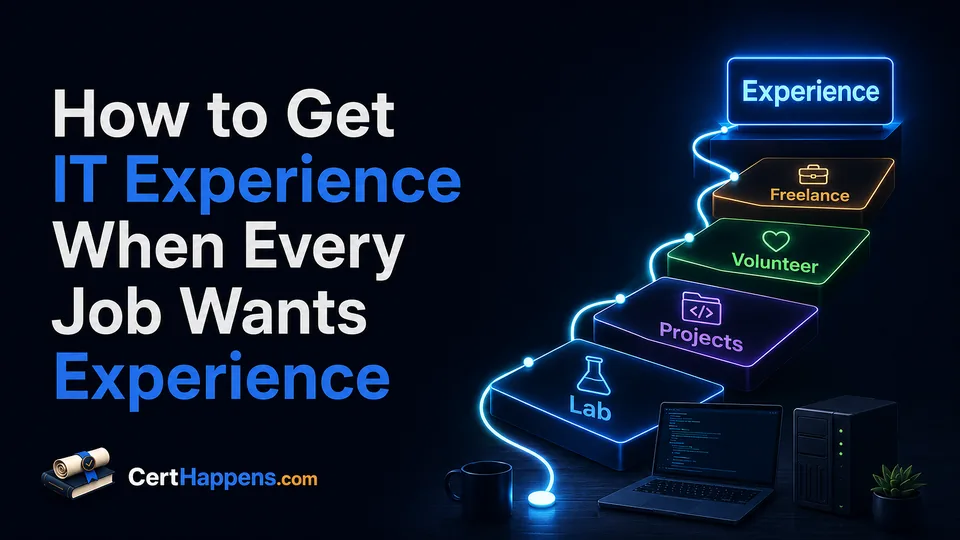
Entry-level technology job listings can create a frustrating loop: you need experience to get the job, but you need the job to get experience.
A full-time IT title is not the only way to start breaking that loop.
Certifications can help demonstrate knowledge. Courses can teach concepts. Labs can build skill. Employers may still want evidence that you have applied what you know to a problem, worked within real constraints, communicated with other people, and finished something useful.
That evidence can begin before your job title says IT.
2. Experience Is Evidence, Not Just Employment
It is easy to treat experience as a number of years attached to a job title. Early in a career, a more useful question is: What can you show that you have actually done?
Useful experience can leave behind evidence such as:
- A problem you diagnosed or solved
- A system you configured, tested, or documented
- A project you completed
- A process you improved
- A script, diagram, runbook, test plan, or other artifact you created
- Feedback from someone who reviewed your work
- A person or organization willing to serve as a reference
Paid employment is strong evidence because the work happened inside a real organization with real expectations. It is not the only evidence available to someone trying to get started.
Internships, part-time roles, volunteer projects, open-source contributions, school projects, home labs, mentoring programs, and technical responsibilities inside a non-technical job can all help build a more convincing story than another line that only says you completed a course.
Be precise about what each experience was. A home lab is not professional employment. Volunteer work is not the same as administering a production environment for years. Both can still demonstrate useful skills when described honestly.
3. Your Current Job May Already Contain Tech Experience
Before searching for a new opportunity, look at the job you already have.
Technology work exists inside accounting, operations, customer service, logistics, healthcare, sales, manufacturing, education, and almost every other field. You may be able to take on a legitimate technical responsibility without changing employers first.
For example:
- An accounting employee may become the person who builds better Excel workbooks, Power Query processes, or Power BI reports.
- An operations employee may help test a new system, document a workflow, track defects, or coordinate with a technology vendor.
- A customer-service employee may reproduce recurring technical issues, improve troubleshooting documentation, or create a clearer escalation process.
- An employee who knows the equipment may help with an authorized device inventory, software rollout, data cleanup, or documentation project.
The key word is authorized. Do not become an unofficial administrator, bypass controls, or make production changes simply because you want experience.
Ask for useful work. Complete it well. Keep track of what you contributed. Your original job title can remain accurate while your resume bullets show that you took on technical responsibilities.
4. Internships Can Still Make Sense When You Have Some Experience
An internship is not a declaration that you know nothing.
Someone who already has technical knowledge may still choose an internship because the environment offers something they do not yet have: mentorship, exposure to larger systems, experience working on a technology team, structured feedback, or a possible path to a full-time role.
That can be a rational trade, especially early in a career.
Instead of asking whether you are "too experienced" for an internship, ask what the opportunity would add:
- Will you work on real technical problems?
- Will someone review your work and explain decisions?
- Will you see tools, processes, or environments you cannot easily reproduce yourself?
- Will you complete work you can describe later?
- Is there a realistic possibility of greater responsibility or a full-time opportunity?
Paid internships are preferable. A lower-paid opportunity may still make sense when the scope is useful, the duration is reasonable, and the experience materially improves your next options.
A title matters less than whether the work moves you forward.
5. Volunteer for a Real, Bounded Project
Community groups, nonprofits, clubs, schools, and other organizations may have legitimate technology work that never becomes a formal job posting.
A useful volunteer project might involve:
- Creating or cleaning up a device inventory
- Documenting a small network or technology process
- Improving a knowledge base or troubleshooting guide
- Helping organize account, software, or equipment records
- Testing a website or internal workflow
- Assisting with an approved migration or rollout
- Improving a simple reporting or data process
Choose work that matches your current level of competence and has clear authorization. Do not use a nonprofit or small organization as a place to experiment on sensitive production systems.
A strong volunteer project has a beginning, an end, and a useful outcome. "Help with computers forever" is not a project plan.
6. Open-Source Contributions Count Too
Open-source work is not limited to writing large amounts of code.
Projects may need help with documentation, testing, reproducing bugs, issue triage, configuration examples, accessibility, small code changes, or explaining how a feature behaves.
A completed contribution can show several things at once:
- You can follow an existing project's standards.
- You can use version control and a review workflow.
- You can communicate about technical work.
- You can respond to feedback.
- You can finish a contribution that someone else finds useful.
Start small. A clear documentation correction or a well-reproduced bug is more credible than claiming you are going to redesign a major project and never submitting anything.
7. Turn Home Labs Into Evidence
A home lab is not job experience, but it can be evidence of practical skill.
The difference is documentation.
Instead of only saying "built a home lab," record what you were trying to accomplish:
- Define the problem or goal.
- Draw or describe the environment.
- Build the configuration.
- Test whether it works.
- Break something on purpose when appropriate.
- Troubleshoot the failure.
- Verify the fix.
- Record what you learned.
A networking learner might build a segmented virtual network and explain how traffic moves between segments. A systems learner might configure users, permissions, services, and backups in virtual machines. A security learner might collect logs, harden a test system, analyze a packet capture, or document how a control changes the observed behavior.
Keep useful artifacts such as sanitized diagrams, configuration examples, scripts, notes, or a repository README. Remove passwords, private addresses that should not be public, proprietary data, and anything else that should remain confidential.
The goal is not to create a giant lab. The goal is to make your reasoning visible.
8. Use Small Paid Projects Carefully
A small paid project can be another bridge into professional experience when the work stays within your current competence.
That might include basic technical documentation, data cleanup, device setup, website maintenance, reporting automation, inventory work, or user support for a small organization.
Keep the scope clear. Get permission before touching systems or data. Be especially cautious with security, production infrastructure, regulated information, and work where a mistake could cause material harm.
Early career experience should expand your skills, not push you into pretending to be an expert in an area you are still learning.
9. Mentorship and Shadowing Can Add Context
Mentorship does not automatically create a resume bullet, but it can make your other experience much better.
A mentor can explain why a team chose one design over another, show how changes are reviewed, help you recognize weak troubleshooting habits, and point out what employers expect from someone at the next level.
When appropriate, ask whether you can contribute to a safe part of the work rather than only observing. Documentation, testing, inventory, lab reproduction, and process improvement can create a bridge from watching to doing.
Describe your contribution accurately. Observing an incident-response meeting is not the same as leading an incident. Helping document the process can still be useful experience.
10. What Makes an Opportunity Worth Your Time?
Early in a career, time is one of your most limited resources. An opportunity does not become valuable just because someone calls it experience.
Look for several of these qualities:
- Useful skill: You will learn or apply something relevant to the work you want.
- Real problem: The task has an actual purpose beyond keeping you busy.
- Defined scope: You can tell when the project or assignment is complete.
- Feedback: Someone can review your work or explain what good work looks like.
- Evidence: You will be able to describe the result or keep a safe artifact.
- Reference value: Someone may be able to confirm what you contributed.
- Reasonable trade: The time, pay, commute, schedule, and opportunity cost make sense for your situation.
Prestige is optional. Useful work is not.
Twenty focused hours on a legitimate project can sometimes give you more interview material than twenty more hours passively watching a course you already understand.
11. Do Not Confuse Experience With Unlimited Free Labor
Paid work is preferable. Your time has value, and needing income does not become less important because you are changing careers.
There are situations where someone may strategically exchange a limited amount of time for experience, mentorship, a reference, or access to work they could not otherwise get. That decision should have boundaries.
Be cautious when:
- The same repetitive unpaid work continues without new learning.
- The scope keeps expanding while the promised mentorship never appears.
- You are given responsibility without the access, training, or authority needed to do it safely.
- Nobody can explain what you are supposed to learn or accomplish.
- The opportunity interferes with paid work, school, family responsibilities, or a more useful path.
- You are pressured to perform work beyond your competence or without proper authorization.
A worthwhile unpaid or low-paid opportunity should be limited in scope, teach useful skills, and leave you with something you can demonstrate afterward.
Experience is the goal. Exploitation is not.
12. Document the Work While You Do It
Do not wait until six months later to remember what happened.
For each project, keep notes on:
- The problem or goal
- The environment and constraints
- What you were responsible for
- The steps you took
- How you tested or verified the result
- What changed because of the work
- What you would do differently next time
Use measurements when you genuinely have them. If you inventoried devices, you can state how many. If an automation saved measurable time, record the before-and-after process. If you do not have a number, do not invent one just because resume advice says every bullet needs a metric.
Protect confidential information. A good interview story does not require exposing a company's internal data, credentials, network details, or customer information.
13. Turn the Work Into Resume and Interview Evidence
Nontraditional experience is easier for an employer to understand when you label it clearly.
Possible headings include:
- Volunteer Technology Project | Community Organization
- Home Lab | Network Segmentation and Logging
- Open-Source Contribution | Project Name
- Technical Projects | Existing Job Title
Then describe what you actually did.
For example, "volunteered with a nonprofit" says very little. "Created a device inventory, documented ownership and support status, and produced a replacement checklist" gives the interviewer something concrete to ask about.
Be ready to explain the problem, what you tried, what went wrong, how you verified the result, and what you learned. That discussion is where a small project can become much more valuable than the size of the project suggests.
14. A Practical Experience-Building Sequence
You do not need to collect every kind of experience at once.
A simple sequence is enough:
- Choose a target role. Identify two or three skills that appear repeatedly in the work you want.
- Look where you already are. Your current job, school, community, or lab may offer the fastest first project.
- Pick one bounded problem. Finish something small enough to complete well.
- Get feedback. Ask someone knowledgeable to review the work when possible.
- Document the evidence. Keep safe artifacts and write down what you learned.
- Add a slightly harder project. Build depth instead of starting ten unrelated labs.
- Apply while you keep learning. Do not wait for a perfect portfolio before pursuing paid opportunities.
Certifications help answer "What do you know?" Practical experience helps answer "What have you done with what you know?"
You usually need some of both. If cost is also limiting your certification plan, How to Study for IT Certifications on a Budget shows how to build the learning side without buying every available resource.