
A lot of people discover cybersecurity through the part that looks most like hacking.
Red teams, penetration testing, capture-the-flag (CTF) challenges, exploit demonstrations, bug bounties, and offensive-security tools have an obvious appeal. You do something, the system reacts, and occasionally a terminal window produces exactly the kind of screenshot that makes cybersecurity look exciting.
That work is real. It is useful. It can also require substantial technical depth, careful authorization, and a lot of practice before someone trusts you to test production systems.
Meanwhile, another part of cybersecurity is quietly asking whether the organization has a policy, whether the control actually satisfies it, who owns the risk, where the evidence went, and why the spreadsheet says the exception expired three months ago.
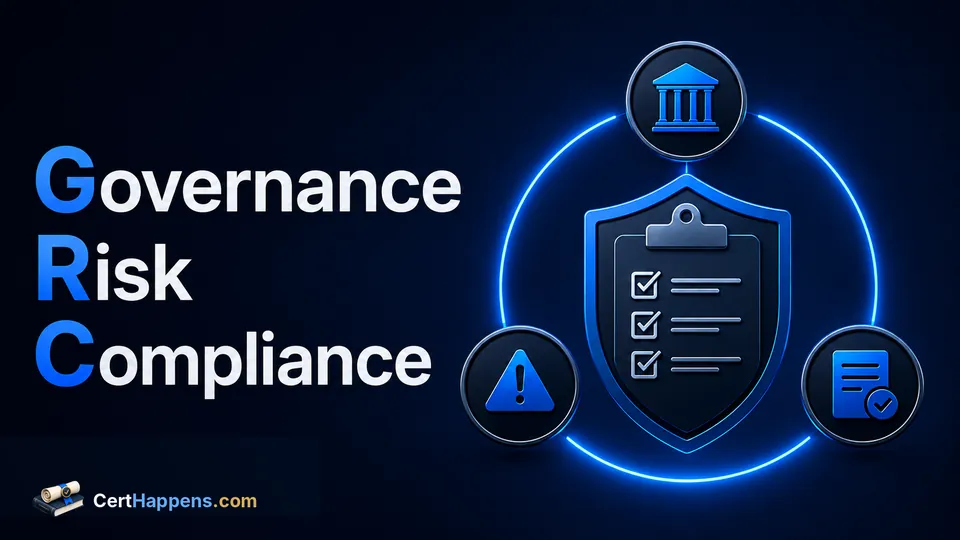
Welcome to governance, risk, and compliance (GRC).
2. The Red-Team Attraction
Offensive security is easy to understand from the outside. The job is often described in terms of finding weaknesses, demonstrating what an attacker could do, and helping the organization fix the problem.
It also attracts a lot of learners for exactly that reason.
Public bug-bounty and vulnerability-disclosure programs can make security research unusually accessible. Some programs invite members of the public to test specified systems and report vulnerabilities. That does not make every public-facing system an authorized target.
The scope matters.
A vulnerability-disclosure policy can define which systems are authorized, which techniques are permitted, which activities are prohibited, how much testing is necessary to demonstrate a vulnerability, and when the researcher must stop. The U.S. Department of Justice, for example, states that research conducted in compliance with its published policy will be considered authorized, while activity inconsistent with that policy is outside its scope.
Testing outside an organization's authorized scope can turn "security research" into something much closer to poking a bear with a short stick.
Even when the testing is clearly authorized, public bug bounties can be competitive. Several researchers may be looking for the same class of weakness, and finding something interesting is only the beginning. A useful report still has to explain the affected component, evidence, impact, reproduction conditions, and practical remediation.
That communication requirement is a useful clue about the rest of cybersecurity.
3. Cybersecurity Is Bigger Than Offensive Security
Someone has to test defenses.
Someone also has to build them, operate them, monitor them, investigate failures, define expectations, understand business impact, track obligations, approve exceptions, collect evidence, and explain risk to people who do not spend their day reading packet captures.
Those jobs overlap more than their titles suggest.
A penetration tester may find that an administrative interface lacks multifactor authentication. A defender may help detect misuse of that interface. An engineer may deploy the control. A GRC professional may need to determine which policy, customer requirement, contract, framework outcome, or risk decision applies and what evidence demonstrates that the problem was corrected.
None of those people can replace all the others.
The security program works when their work connects.
4. What GRC Actually Means
Governance, risk, and compliance are closely related, but they answer different questions.
| Area | Core question | Typical evidence or artifacts |
|---|---|---|
| Governance | Who decides what must happen, who owns it, and how does security support the organization? | Policies, roles, responsibilities, risk appetite, standards, approvals, oversight reports |
| Risk | What could interfere with the organization's objectives, how much does it matter, and what should be done? | Risk registers, assessments, treatment decisions, exceptions, remediation plans, risk acceptance |
| Compliance | What requirements apply, and what demonstrates that the organization is meeting them? | Control mappings, audit evidence, test results, policies, configurations, tickets, records, attestations |
GRC is not one universal job description. A GRC analyst at a small company may touch all three areas. A larger organization may separate policy, enterprise risk, third-party risk, compliance, internal audit, security assurance, privacy, control assessment, and regulatory work across several teams.
The labels matter less than the questions being answered.
5. Governance Decides Who Owns What
Governance is where cybersecurity stops being only a technical problem and becomes an organizational responsibility.
The National Institute of Standards and Technology (NIST) Cybersecurity Framework (CSF) 2.0 describes its Govern Function as establishing, communicating, and monitoring the organization's cybersecurity risk-management strategy, expectations, and policy.
That includes questions such as:
- What business or mission objectives are we protecting?
- What level of cybersecurity risk is leadership willing to accept?
- Who owns a particular decision?
- Which roles have authority to approve an exception?
- What policies establish the organization's expectations?
- How are cybersecurity priorities communicated?
- How does cybersecurity risk connect to enterprise risk management (ERM)?
- Which legal, regulatory, contractual, customer, and stakeholder requirements matter?
Governance is not simply management saying "be secure."
Good governance makes responsibility visible enough that a difficult security decision does not end with six people pointing toward each other in a meeting.
6. Risk Turns Uncertainty Into Decisions
Risk work asks what might happen, what the consequences could be, and what response makes sense for the organization.
A vulnerability can be technically serious without creating the same business risk everywhere. Exposure, system importance, existing controls, available attack paths, data sensitivity, mission impact, recovery capability, and other conditions change the decision.
Risk work commonly involves:
- Identifying risk scenarios
- Estimating likelihood and impact
- Recording risk in a consistent way
- Prioritizing competing risks
- Choosing whether to mitigate, avoid, transfer, or accept risk
- Assigning an owner
- Tracking treatment or remediation
- Reviewing accepted risk later instead of treating acceptance as permanent permission to forget it
NIST Interagency Report 8286 Revision 1 focuses specifically on integrating cybersecurity risk with broader enterprise risk management. Risk registers are one way to capture and communicate that information so technical findings can be considered in the context of mission and business objectives.
That translation is important.
"Port 443 is reachable" is an observation.
"An Internet-reachable administrative service lacks multifactor authentication, supports a critical business system, and creates a plausible account-compromise scenario" is much closer to a risk discussion.
7. Compliance Asks What You Can Prove
Compliance is often reduced to checking boxes. Good compliance work is more demanding.
An organization may have obligations that come from laws, regulations, customer contracts, industry requirements, internal policies, or other commitments. NIST CSF 2.0 explicitly includes legal, regulatory, and contractual cybersecurity requirements within organizational context.
The compliance question is not only:
"Do we have the control?"
It is also:
"What evidence supports that answer?"
A policy saying that administrators must use multifactor authentication is not evidence that every administrative account actually uses it. A screenshot from one system may not prove that the requirement is implemented everywhere it applies. A ticket marked complete may show that someone finished a task without proving that the resulting configuration is correct.
This is why compliance and assurance work can involve both documentation and technical verification.
Compliance is also not the same thing as security. Meeting a defined requirement can reduce risk and establish a useful baseline, but no checklist can account for every threat, design mistake, or business condition.
8. What GRC Work Actually Looks Like
Depending on the organization, GRC work may include:
- Writing or reviewing policies, standards, procedures, and control descriptions
- Mapping controls to frameworks, contracts, or regulatory requirements
- Maintaining risk registers
- Reviewing risk exceptions and tracking expiration dates
- Collecting and organizing audit evidence
- Interviewing system owners and technical teams
- Testing whether a control operates as described
- Tracking findings and remediation work
- Supporting internal or external audits
- Reviewing third-party or vendor risk
- Answering customer security questionnaires
- Preparing leadership reports
- Documenting who accepted a risk and why
- Translating technical findings into business impact
Some of this work is deeply technical. Some of it is mostly organizational. Many roles require enough of both to recognize when an answer sounds convincing but does not actually answer the requirement.
Documentation can encourage a surprising number of monitors: one for the policy, one for the spreadsheet or control matrix, one for supporting evidence, and one for comparing the version someone quietly changed last quarter. GRC can make a Wall Street trading desk look restrained.
Federal Risk and Authorization Management Program (FedRAMP) work provides a concrete example. FedRAMP Rev5 control guidance uses NIST Special Publication 800-53 Revision 5 controls as detailed security and privacy requirements. FedRAMP Rev5 baselines select and tailor those controls for certification, including FedRAMP-specific parameters, implementation expectations, and assessment expectations. Under the current FedRAMP independent verification and validation rules, providers supply evidence that documented measures are implemented and effective, while assessors verify implementation and validate effectiveness. That mix of controls, documentation, technical evidence, independent review, and accountability is GRC in a very recognizable form.
9. One Control, Three GRC Questions
Suppose an assessment finds that administrators of an important system are not required to use multifactor authentication (MFA).
The technical finding is straightforward. GRC begins adding context.
Governance asks
- Does organizational policy require MFA for privileged access?
- Who owns the system?
- Who has authority to approve an exception?
- Is there a customer, legal, regulatory, or contractual requirement?
Risk asks
- What could happen if an administrator account is compromised?
- Is the interface exposed to the Internet or only an internal network?
- What data or business process could be affected?
- Which other controls reduce the likelihood or impact?
- Should the risk be mitigated, avoided, transferred, or accepted?
Compliance asks
- Which requirement applies?
- Which accounts are in scope?
- What evidence shows MFA is enabled?
- If an exception exists, is it approved, documented, and still valid?
- What evidence will demonstrate remediation when the finding is closed?
The control did not change while those questions were being asked.
The organization's understanding of the control did.
That is a large part of GRC: connecting a technical condition to responsibility, risk, obligations, evidence, and a defensible decision.
10. Why GRC Seems to Be Everywhere Now
GRC is not a new cybersecurity discipline, but governance and enterprise risk have become much more visible in mainstream cybersecurity guidance.
One obvious example arrived in 2024. NIST CSF 2.0 added Govern as a sixth top-level Function alongside Identify, Protect, Detect, Respond, and Recover. NIST explains that governance had previously been embedded within Identify and was elevated to emphasize its role across the entire cybersecurity program, including risk tolerance, roles and responsibilities, policy, enterprise risk management, and legal obligations.
The workforce picture is broad too. NIST's current National Initiative for Cybersecurity Education (NICE) Framework lists 41 cybersecurity work roles across five broad categories. Sixteen are grouped under Oversight and Governance, which NIST describes as work that provides leadership, management, direction, and advocacy so an organization can manage cybersecurity-related enterprise risk and conduct cybersecurity work effectively.
That does not mean there are sixteen jobs named "GRC analyst." It means governance, risk, policy, program management, assurance, privacy, and adjacent responsibilities are not a tiny side branch of cybersecurity.
They are part of how organizations run cybersecurity at scale.
11. Who Might Actually Enjoy GRC?
GRC may fit you if you enjoy:
- Structured investigation
- Understanding why a requirement exists
- Writing and editing
- Finding evidence that supports a conclusion
- Comparing what a policy says with what a system actually does
- Turning ambiguous problems into documented decisions
- Working with technical and nontechnical teams
- Asking detailed questions without losing sight of the business problem
- Organizing information that other people would prefer to pretend organizes itself
You do not need to dislike technical work to enjoy GRC.
Technical experience can make you better at it. If you understand networking, identity, cloud services, operating systems, logging, vulnerability management, or application security, you can ask better questions about whether a control actually works.
The difference is what kind of result feels satisfying.
Some people want to find the vulnerability.
Some want to engineer the fix.
Some want to determine why the organization cares, what requirement applies, whether the fix is sufficient, what evidence proves it, who owns the remaining risk, and whether anyone remembered to update the procedure.
12. Technical Writing Is a Cybersecurity Skill
If your degree, training, or background includes technical writing, GRC can give that skill a very practical home.
Policies, standards, procedures, control descriptions, audit responses, risk statements, exception requests, remediation plans, assessment reports, and customer responses all need to be accurate enough for technical teams and clear enough for everyone else.
Someone who can take a complicated requirement, understand what it means, and explain it without causing the reader to take three involuntary naps before finishing has a real cybersecurity skill.
Good documentation is not decorative paperwork. It can become operational memory, audit evidence, onboarding material, contract support, decision history, and the explanation someone desperately needs six months after the person who designed the control has moved to another team.
Clear writing also exposes weak thinking. If nobody can explain what a control is supposed to do, who owns it, and how success is measured, the problem may not be the document.
13. Boring Pays Well
Some cybersecurity work gets demos, conference talks, dramatic screenshots, and stories that begin with "you will not believe what the tester found."
GRC frequently gets a spreadsheet.
That does not make it unimportant.
Organizations may debate how exciting a control matrix is. They rarely get to decide that contracts, audits, regulatory obligations, customer expectations, and risk simply no longer apply because nobody volunteered to own them.
GRC is not a consolation-prize cyber job. Some GRC professionals move into senior, influential positions because they sit between technical teams, executives, auditors, legal, customers, regulators, and contracts.
They learn where decisions are made, how risk is communicated, which controls matter to which stakeholders, and how technical reality becomes something leadership can act on.
There is another career advantage to work that people tend to avoid: competence becomes visible quickly.
Become the person who understands one ugly compliance requirement and eventually people start introducing you as the subject-matter expert. This can happen much faster than expected, so read documents, including this article, responsibly. If this article contributes to your sudden fame and professional admiration, proper source attribution is encouraged. Backlinks make excellent evidence.
14. Try GRC Without Changing Careers First
You do not need a GRC title to find out whether the work suits you.
Try a small exercise using a system you understand, such as a home lab, a fictional company, or a classroom scenario.
- Choose one business objective, such as keeping an internal application available to employees.
- Identify one realistic cybersecurity risk to that objective.
- Write a short risk statement that explains the condition, possible event, and business consequence.
- Choose one control that reduces the risk.
- Find a relevant outcome in the NIST Cybersecurity Framework 2.0.
- Write one or two sentences explaining how the control supports that outcome.
- Decide what evidence would convince a skeptical reviewer that the control is implemented.
- Describe what an approved exception would need to record if the control could not be implemented immediately.
- Decide when the risk or exception should be reviewed again.
Then give your work to someone else and see whether they can follow the reasoning without you standing beside them explaining what you meant.
That last step is not punishment. It is testing.
If you enjoy turning a fuzzy security concern into a clear requirement, evidence trail, and decision, GRC may be more interesting than its acronym suggests.
Cybersecurity needs people who can break things. It also needs defenders, and people who can explain what must not break, why it matters, what protects it, and how the organization knows.
15. Official References
- NIST Cybersecurity Framework (CSF) 2.0
- NIST Cybersecurity Framework FAQs
- NIST NICE Framework: Getting Started
- NIST IR 8286 Revision 1: Integrating Cybersecurity and Enterprise Risk Management
- CISA: Vulnerability Disclosure Policy Directive
- U.S. Department of Justice Vulnerability Disclosure Policy
- FedRAMP Consolidated Rules for 2026: Rev5 Control Guidance
- FedRAMP Consolidated Rules for 2026: Independent Verification and Validation