
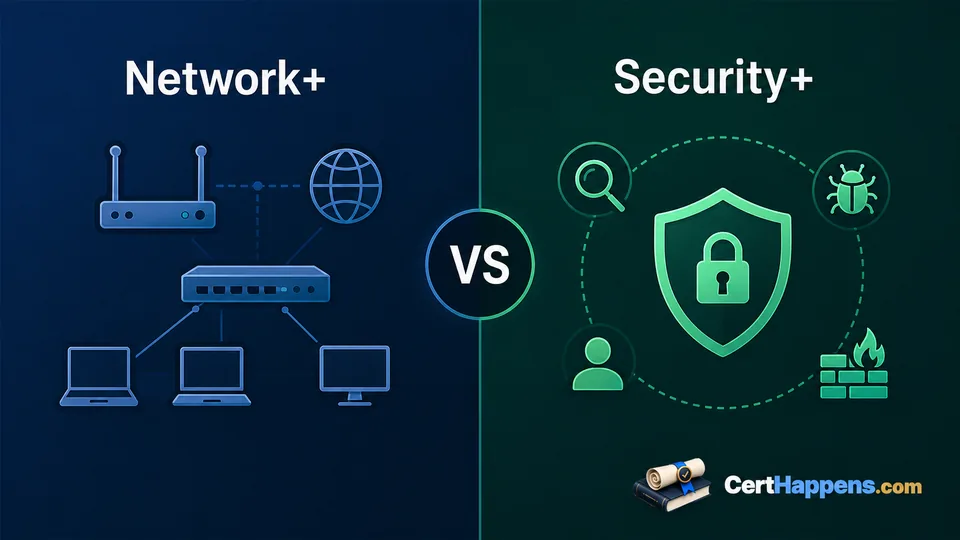
Network+ and Security+ are often mentioned together by people trying to enter cybersecurity. That can make them look like two steps in one required sequence. They are not.
Network+ teaches you how networks work, how they are built, and how to troubleshoot them. Security+ teaches you how to protect systems, networks, users, and data. It also covers how organizations respond when something goes wrong.
There is overlap, but the center of each exam is different.
You do not need to choose by reputation. Start with the knowledge gap that would slow you down most.
2. The Short Answer
Take Network+ first if networking still feels uncertain. If you regularly stop to look up basic addressing, ports, Domain Name System (DNS), Dynamic Host Configuration Protocol (DHCP), routing, virtual local area networks (VLANs), or common network devices, Network+ can give you the structure you are missing.
Take Security+ first if the networking foundation is already there and your next goal is security. You should be able to follow how systems communicate, understand common services, and troubleshoot basic connectivity without learning all of that from scratch at the same time.
If a job or employer specifically requires one certification, that requirement matters. You can fill smaller knowledge gaps separately.
The important distinction is simple:
You may not need the Network+ certification before Security+, but you do need enough networking knowledge for security concepts to make sense.
3. Network+ and Security+ Exam Snapshot
The current CertHappens material follows Network+ N10-009 and Security+ SY0-701.
| Comparison | Network+ N10-009 | Security+ SY0-701 |
|---|---|---|
| Main focus | Networking concepts, implementation, operations, security, and troubleshooting | Security concepts, threats, architecture, operations, governance, and oversight |
| Maximum questions | 90 | 90 |
| Test length | 90 minutes | 90 minutes |
| Question styles | Multiple-choice and performance-based | Multiple-choice and performance-based |
| CompTIA recommended experience | 9 to 12 months in IT networking | At least 2 years in IT administration, including security-focused and hands-on security experience |
Those experience recommendations are useful context. They are not a rule that says you must earn Network+ before you can study Security+.
The Network+ objectives devote 14% of the exam to Network Security. That matters because Network+ is not a security-free certification. You learn security in the context of building and operating networks.
4. What Network+ Builds
Network+ is about understanding the network as a working system.
You learn what the pieces do and how they fit together. You also learn how to find a failure when the network stops behaving normally.
That includes topics such as:
- Routers, switches, firewalls, wireless access points, and other network devices
- Internet Protocol (IP) addressing and subnetting
- Ports, protocols, and common network services
- Wired and wireless connections
- Cloud and virtual networking
- VLANs and network segmentation
- Network monitoring and documentation
- Network security controls
- A structured troubleshooting process
The current N10-009 objectives put the largest single share of the exam on Network Troubleshooting at 24%. Networking Concepts follows at 23%.
That tells you something important about the certification. It is not only a vocabulary exam. You need to understand what normal network behavior looks like so you can recognize what is wrong.
What that looks like in practice
Suppose a workstation can reach another computer on the same local network but cannot open a website.
A networking-focused investigation might ask:
- Does the workstation have the correct IP address?
- Is the default gateway correct?
- Can it reach the gateway?
- Is DNS resolving the website name?
- Is a firewall blocking the traffic?
- Is the problem local, or does it affect other devices?
Network+ gives you a framework for working through questions like these.
5. What Security+ Builds
Security+ starts from a different question:
How do we reduce harm, detect problems, and respond when protections fail?
The current SY0-701 exam covers five broad areas:
- General Security Concepts
- Threats, Vulnerabilities, and Mitigations
- Security Architecture
- Security Operations
- Security Program Management and Oversight
Security Operations is the largest domain at 28%.
The exam moves beyond network protection. It includes identity and access, cryptography, system hardening, vulnerabilities, incident response, governance, risk, third parties, security policies, and many other areas.
What that looks like in practice
Suppose monitoring shows unusual outbound traffic from a server.
A security-focused investigation may ask:
- Is the traffic expected for this server?
- What process or account created it?
- Is the destination known or suspicious?
- What logs can confirm what happened?
- Should the server be isolated?
- What evidence should be preserved?
- Which control failed or was missing?
- What should change so the problem is less likely to happen again?
Notice that networking knowledge still matters. You need to understand the connection before you can decide whether it is suspicious.
6. Where Network+ and Security+ Overlap
The exams are not separate worlds.
Network+ includes security because a network must be protected while it is designed, configured, and operated. Security+ includes networking because attackers, users, applications, and security controls all communicate across networks.
Both may require you to understand concepts such as:
- Firewalls
- Network segmentation
- Virtual private networks (VPNs)
- Wireless security
- Authentication
- Common ports and protocols
- Network attacks
- Secure network design
- Monitoring and logs
The difference is the reason you are learning them.
With Network+, a firewall is one part of network infrastructure. You care about where it sits, what traffic it controls, and how it affects connectivity.
With Security+, the firewall is one control among many. You also care about threats, access decisions, incident response, policy, risk, and whether other controls are needed.
7. Take Network+ First When
Network+ is usually the better first step when the network itself is still hard to picture.
Consider Network+ first if several of these statements sound familiar:
- I can name network devices, but I am not always sure what each one does.
- IP addresses and subnet masks still feel like numbers to memorize.
- I confuse DNS, DHCP, and default gateways.
- I know common ports only as flash-card facts.
- I have trouble following traffic from one system to another.
- VLANs, routing, and network segmentation are still new.
- I am not confident troubleshooting a basic connectivity problem.
- I want to work in support, networking, systems, cloud, or security, but my network foundation is weak.
This does not mean you have to become a network engineer before learning security.
It means you should understand enough networking that a security lesson is not also your first lesson in how computers communicate.
Why this can make Security+ easier to understand
Consider a Security+ question about blocking malicious traffic between two network segments.
If you already understand IP addresses, routing, VLANs, ports, and firewalls, you can focus on the security decision.
If those networking concepts are all new, you are solving two problems at once. You are learning what the network does and trying to learn how to secure it.
That is where Network+ can help.
8. Take Security+ First When
Security+ can be the better first exam when networking is already comfortable enough to support the security material.
Consider Security+ first if several of these statements fit:
- I can explain the basic roles of a switch, router, firewall, and wireless access point.
- I understand IP addresses, subnets, gateways, DNS, DHCP, and common ports.
- I can follow a simple path from a client to a server.
- I have already worked in IT support, systems administration, networking, cloud, or another technical role.
- I want to move toward security operations, security administration, or another cybersecurity role.
- I am comfortable reading basic logs and troubleshooting system problems.
- The jobs I am targeting specifically mention Security+.
- Networking is not my strongest topic, but it is not stopping me from understanding security scenarios.
You do not need perfect networking knowledge.
Security professionals look things up. Network engineers do too.
The question is whether basic networking is familiar enough that it supports your security study instead of dominating it.
9. Can You Skip Network+ and Go Straight to Security+?
Yes, when you already have the networking knowledge.
This is where knowledge and certification should be separated.
You may have learned networking through:
- IT support work
- Systems administration
- Cloud administration
- A college course
- A home lab
- Military or government technical work
- Another certification
- Years of solving real network problems
If that experience already covers the Network+ foundation, earning the Network+ credential may add less value than moving directly to Security+.
Do not take an exam only because someone says the certifications must be collected in a certain order.
At the same time, do not skip the knowledge just to reach the security label faster.
You can fill a smaller gap without taking the exam
Perhaps your networking is solid except for subnetting and wireless standards. You may not need months of Network+ study.
Review those weak areas. Build a small lab. Use the Network+ study guide as a checklist.
Then return to Security+.
10. A Simple Networking Self-Check Before Security+
Before deciding, see whether you can explain these without relying on memorized definitions alone:
- What does a default gateway do?
- What is the difference between DNS and DHCP?
- Why would a switch, router, and firewall appear in different places on a network?
- What does a port number tell you about network traffic?
- What is a subnet, and why would an organization use more than one?
- What is a VLAN, and how can segmentation improve security?
- If a computer can reach an IP address but not a website name, what would you check?
- If one device has no network access but every other device works, where would you start?
You do not need a perfect answer to every question.
If several are difficult to explain, Network+ study can make Security+ easier.
If these feel routine, you may be ready to spend your time on security instead.
11. If You Already Have A+, CompTIA Stacking May Affect the Order
If Network+ and Security+ both fit your goals, an existing A+ certification can add one more consideration.
CompTIA recognizes these combinations:
- CIOS: A+ + Network+
- CSIS: A+ + Network+ + Security+
If you already hold active A+, taking Network+ first can complete the CIOS combination. Adding Security+ later can complete CSIS.
If you do not hold A+, this stacking benefit does not by itself make Network+ the correct first exam. Security+ may still be the better choice when your networking foundation is already solid or a target job specifically asks for it.
Use the stackable credential as a tie-breaker when the underlying certification sequence already makes sense.
Do not reverse a better learning or employment path only to collect the stack.
12. Practical Study Orders
There is no universal certification ladder. A useful order depends on where you are starting.
New to hands-on IT
Build basic computer and operating-system skills first. Then learn networking. Security makes more sense after you understand the systems being protected.
A possible sequence is:
A+-level skills → Network+ → Security+
You may or may not need to earn A+. The skills are the important part.
IT support experience, but weak networking
Start with Network+.
You likely understand users, devices, accounts, operating systems, and common support problems. Networking is the missing layer.
A practical sequence is:
Network+ → Security+
Network or systems experience with a security goal
Security+ may be the better next step.
You already work with much of the technical foundation. Use Security+ to organize security concepts around knowledge you have gained in practice.
A practical sequence may be:
Security+
Already studying Security+ and discovering network gaps
You do not always need to stop and switch exams.
If the gaps are limited, review the Network+ topics that are blocking you. Then continue Security+.
If nearly every security topic depends on networking concepts you do not understand, switching to Network+ for a while may save time overall.
A job requires Security+
Study toward the requirement, but be realistic about your foundation.
Use targeted Network+ material to fill the networking gaps that make Security+ difficult. You do not necessarily need to earn both credentials before applying.
13. Common Mistakes When Choosing Between Them
Treating Security+ as a higher version of Network+
It is not.
Security+ covers a different subject. It builds on general technical understanding, but it is not Network+ with harder questions.
Assuming Network+ must be earned first
The current Security+ objectives list recommended experience. They do not list Network+ certification as a required step.
If you already know networking, you may not gain much from proving the same foundation twice.
Skipping networking because you want a security job
Cybersecurity still depends on networks.
A security alert often includes addresses, ports, protocols, domains, services, routes, and network segments. Those details are not background noise. They help explain what happened.
Choosing only by which certification sounds more valuable
The best certification is the one that closes a real gap or supports a real next step.
A Security+ credential does not fix weak networking. A Network+ credential does not teach the full range of security operations, governance, identity, cryptography, and incident response.
Studying both exams at the same time without a reason
There is overlap, but each exam has a large amount of material outside that overlap.
For most learners, one clear target is easier to manage. Finish the foundation you need, then move forward.
14. Check the Current CompTIA Details
Exam versions, policies, and objectives can change. Confirm the current information before buying a voucher or choosing study materials.
If you are still deciding among more than these two certifications, use Which IT Certification Should You Earn First? for a broader comparison.